Frederick Burr Opper | 1857-1937
Life & Work
Frederick Burr Opper (1857–1937) was a pioneer of American newspaper comic strips, best known for Happy Hooligan. Across nearly six decades, his characters appeared in magazine gag cartoons, covers, political cartoons, and daily comic strips.
Born in Madison, Ohio, to Austrian-American immigrants Lewis and Aurelia Burr Opper, he was the eldest of three children. At fourteen, Opper left school to work as a printer’s apprentice at the Madison Gazette. Two years later, he moved to New York City, working days in a store while continuing to draw. His formal training was brief, consisting of study at Cooper Union and a short period as pupil and assistant to illustrator Frank Beard.
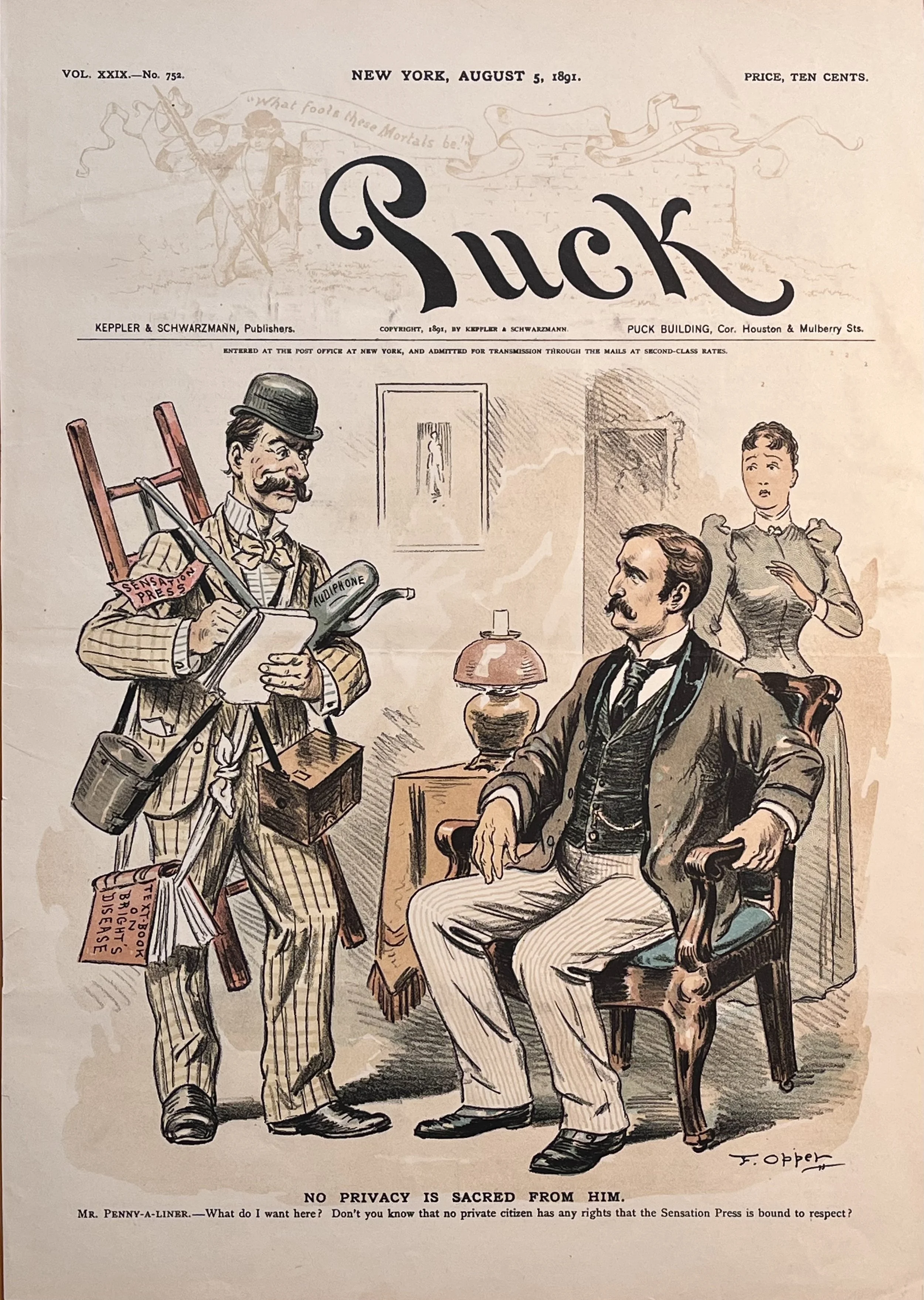
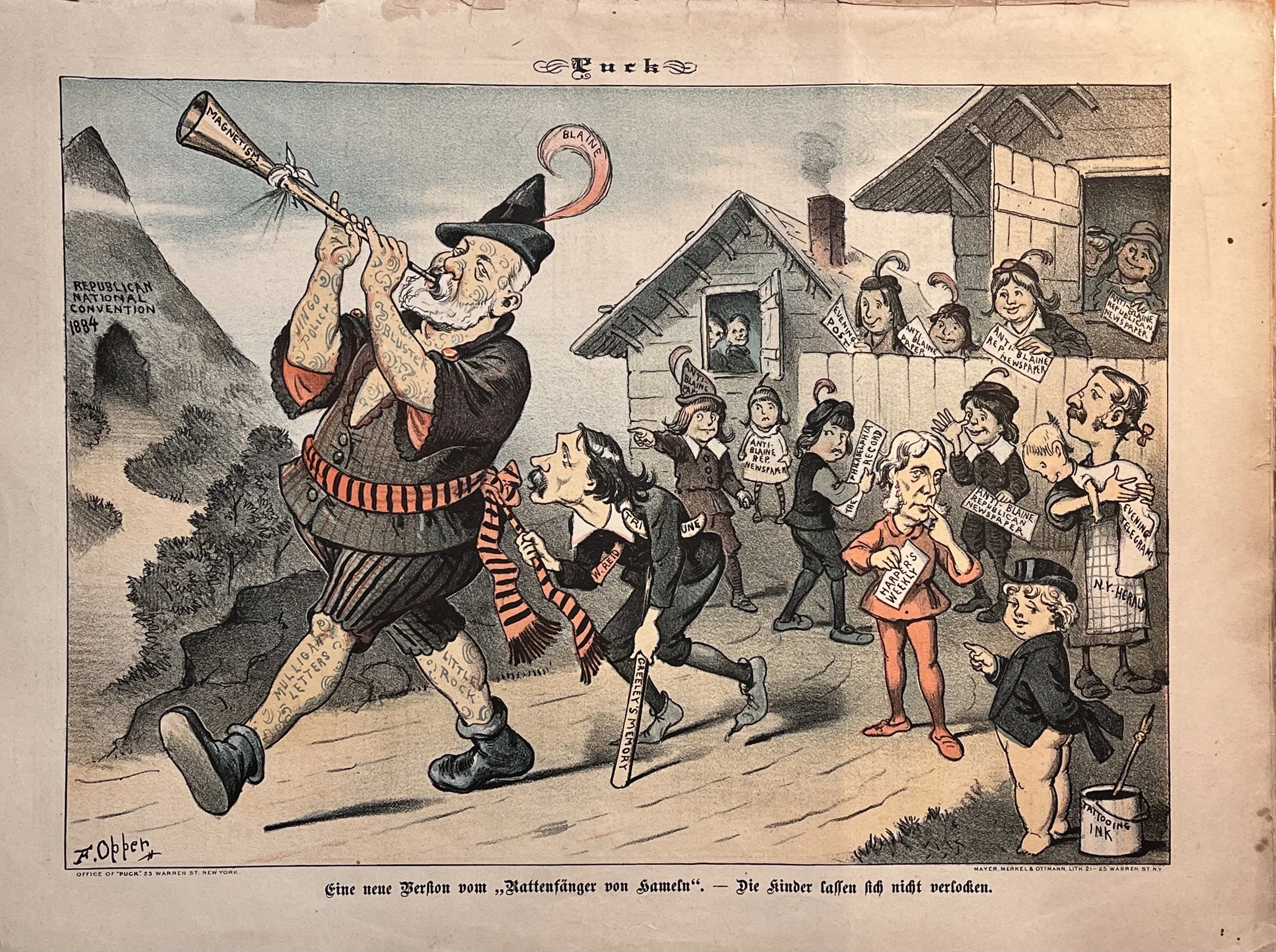
Opper’s first published cartoon appeared in Wild Oats in 1876, followed by work in Scribner’s Monthly and St. Nicholas. From 1877 to 1880, he worked as an illustrator for Frank Leslie’s Weekly. He was then hired by Puck, where he remained for eighteen years, producing everything from spot illustrations to chromolithograph covers. Opper married Nellie Barnett in 1881.
Political Focus
Opper’s political cartoons translated abstract forces into human form. Trusts, corporations, political figures, and public institutions appear as exaggerated personalities whose size, posture, and behavior reveal the imbalance of power they wield.
Rather than relying on topical complexity, Opper favored repetition and accumulation. Through recurring figures—most notably the vulnerable “little man” confronting oversized interests—his cartoons built sustained critique across days and years. Authority is not simply mocked but rendered absurd through familiarity.
This approach proved especially effective in the early twentieth century, when Opper’s images circulated nationally through daily newspapers. His work helped establish a visual language for political satire that treated economic power and governance as lived experience, shaping how mass audiences understood inequality, bureaucracy, and public life.